
Self-doubt can make a person overlook an opportunity, avoid a visible responsibility, or dismiss a skill they already use. The practical response is to name the belief, take one small action that tests it, and let observed work replace the old label.
Short answer: Self-doubt changes what you notice. When you decide you are not a numbers person, presenter or salesperson, you can walk past the evidence that an opportunity is already in front of you. The way out is not a motivational speech. Name the sentence, take one small visible action, and let the work update the label.
Somewhere this year you talked yourself out of something.
That decision is still setting your ceiling.
You looked at it twice. You told yourself it was not you. Then you let it go. Nothing about the room changed. Only your sentence about yourself did.
The message in the newspaper
Richard Wiseman spent ten years researching luck. He worked with people who called themselves lucky and people who called themselves unlucky. Both groups got the same room, the same newspaper and the same instruction: count the photographs. His account of the experiment is worth reading because the point is not magic. It is attention.
On page two, in type more than two inches high, half the page said, “Stop counting. There are 43 photographs in this newspaper.”
The lucky group tended to spot it. The unlucky group tended to keep counting.
Halfway through, a second message offered 250 pounds to anyone who told the experimenter they had seen it. The same split showed up.
Nobody hid anything from either group. What you believe about yourself edits what you see.
That is not a reason to call yourself lucky. It is a reason to examine the sentence you carry into the room. The sentence decides what counts as evidence and what gets dismissed as something meant for somebody else.
Five sales moves to write over
Save this for the next time you pass on something in the MSP sales journey and feel your stomach drop.
- “I am not a numbers person.” Before the next prospect meeting, open the domain or client report and write three questions about the condition, the owner and the next step.
- “I would be terrible at presenting.” Claim the five-minute opening in the next discovery call or QBR and explain one finding in plain language.
- “They need someone more senior for that.” Ask to sit in on the next meeting where a prospect's fit, scope or first project gets decided.
- “I could never write like that.” Write the four-paragraph follow-up yourself: finding, consequence, owner and next choice.
- “I am the quiet one on the team.” Put one evidence-led question in writing and send it before the next sales meeting so the conversation starts with the prospect's environment.
The actions are deliberately small. They are not a test of whether you feel ready. They are a way to collect new evidence about the sentence.
The sales version of the newspaper
An MSP seller can spend a week counting the photographs: rewriting the services page, checking the CRM fields, waiting for the perfect case study, or deciding that the prospect is too senior to call. None of those tasks is the meeting. They are ways to stay near sales without asking for a decision.
The message is already on page two. The prospect has a public domain condition you can explain, such as mail authentication set to monitor-only or a login surface indexed where anyone can find it. The owner has a question about the cost of leaving it open. The next meeting needs an evidence-backed reason to exist.
The sentence says, “I am not a salesperson.” The work says something else. You researched the account, found a condition, explained what it could mean and asked who owns the next decision. That is an MSP sales motion, even if you never use the word.
The lucky move is not to pretend every account is a good opportunity. It is to notice the opportunity that is actually there, name the limit, and ask the next useful question.
I was already selling
I started out technical. For my first five years I turned down anything with sales in the title.
Then I became a consultant. My job was to explain a customer's problem and how I would fix it.
That was selling.
I was already fairly good at it. I could not see it because I had decided I was not a salesperson. One day somebody said it out loud.
The day I took the label, I got better at it. Not because a label gave me a new personality. Because I stopped spending energy proving the old sentence right.
The same thing happens to MSP owners. A technical founder says they are bad at sales, then writes a thoughtful explanation of a client's problem, recommends a responsible next step and earns agreement to do the work. The behavior is there. The label is lagging behind it.
Evidence helps because it gives the conversation something more solid than confidence to stand on. A dated finding, its source and its limit can carry the first question while the person does what they already know how to do: listen, explain and help.
Go back to the thing you passed on
Read what you told yourself about it. Was it really a capability gap, or was it an identity sentence you had repeated until it sounded like a fact?
You wrote the ceiling yourself.
You can write over it this week. Start with the smallest action that puts you near the work. Let the result become the next piece of evidence.
Frequently asked questions
Why do people miss opportunities that are in front of them?
A belief about who they are can edit what they notice. If someone has decided they are not a numbers person, presenter, salesperson or senior enough, they may keep counting the old problem and miss the invitation to act.
How can an MSP owner become more confident in sales?
Start with work you already do that creates value for a customer, name it as a sales skill, and take one small visible step this week: present the update, ask the question or write the recap yourself.
What is the first step when an opportunity feels out of reach?
Read the sentence you told yourself about why it was not for you. Then choose a small action that puts you closer to the work without pretending you already know everything.
Can a technical person learn to sell managed services?
Yes. Explaining a customer's problem, showing the evidence and describing a responsible fix is already a form of selling. The label can change after the behavior is already there.
How does SCOUTz help an MSP show up with more confidence?
SCOUTz gives the MSP dated, source-labeled prospect evidence and visible limits, so the first conversation can start with a real question instead of a performance of certainty.
How SCOUTz gets you there
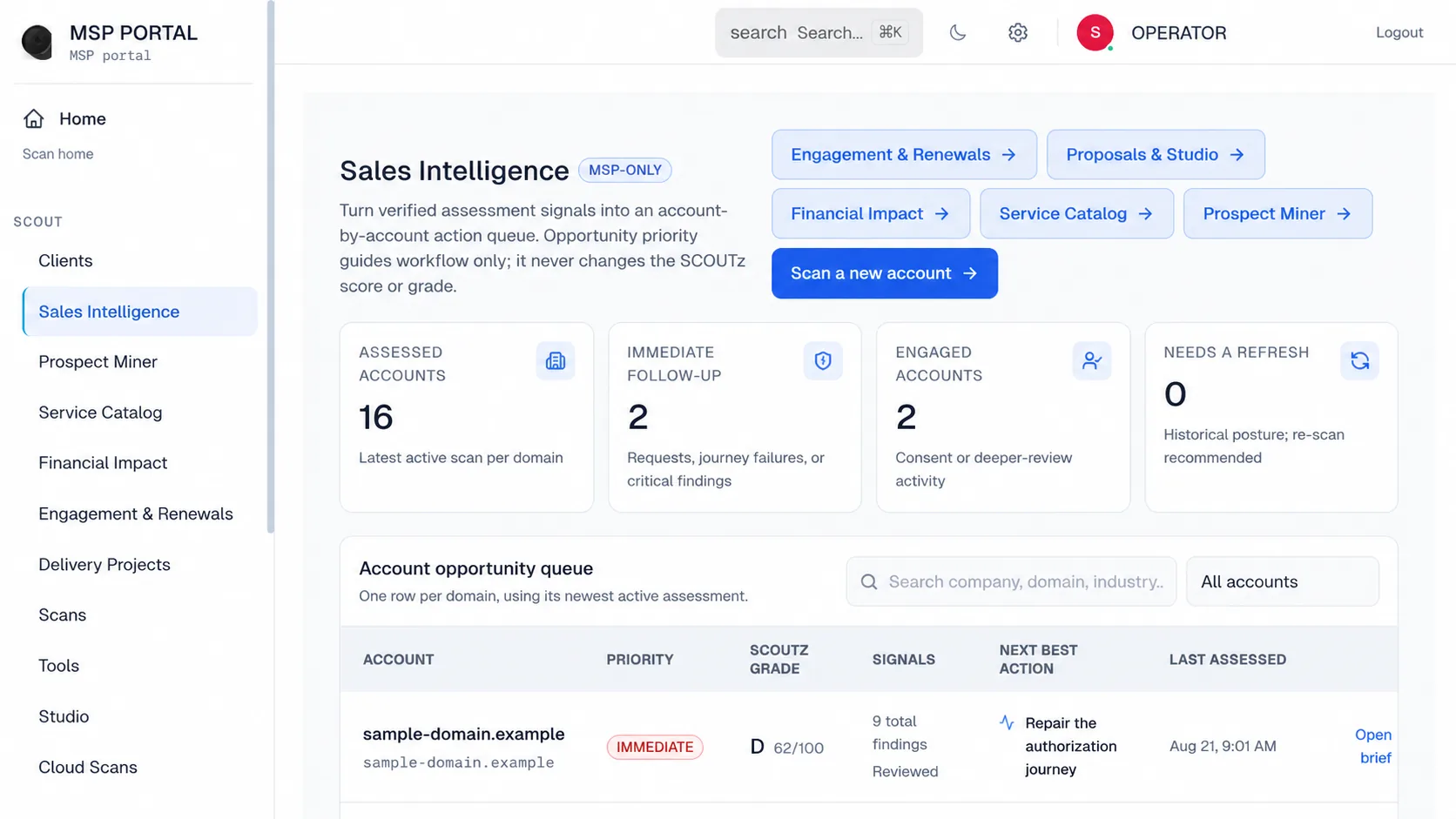
SCOUTz is prospect intelligence for MSPs. It gives the technical person a bounded, evidence-backed starting point before the first conversation, so confidence does not have to come from pretending to know everything. The domain report shows what is public, names what it cannot prove and turns one observation into a useful sales question. When the prospect authorizes a deeper review, Microsoft 365 evidence can be added without losing the boundary. That is how a person can take the label they have been avoiding and let the work speak first.