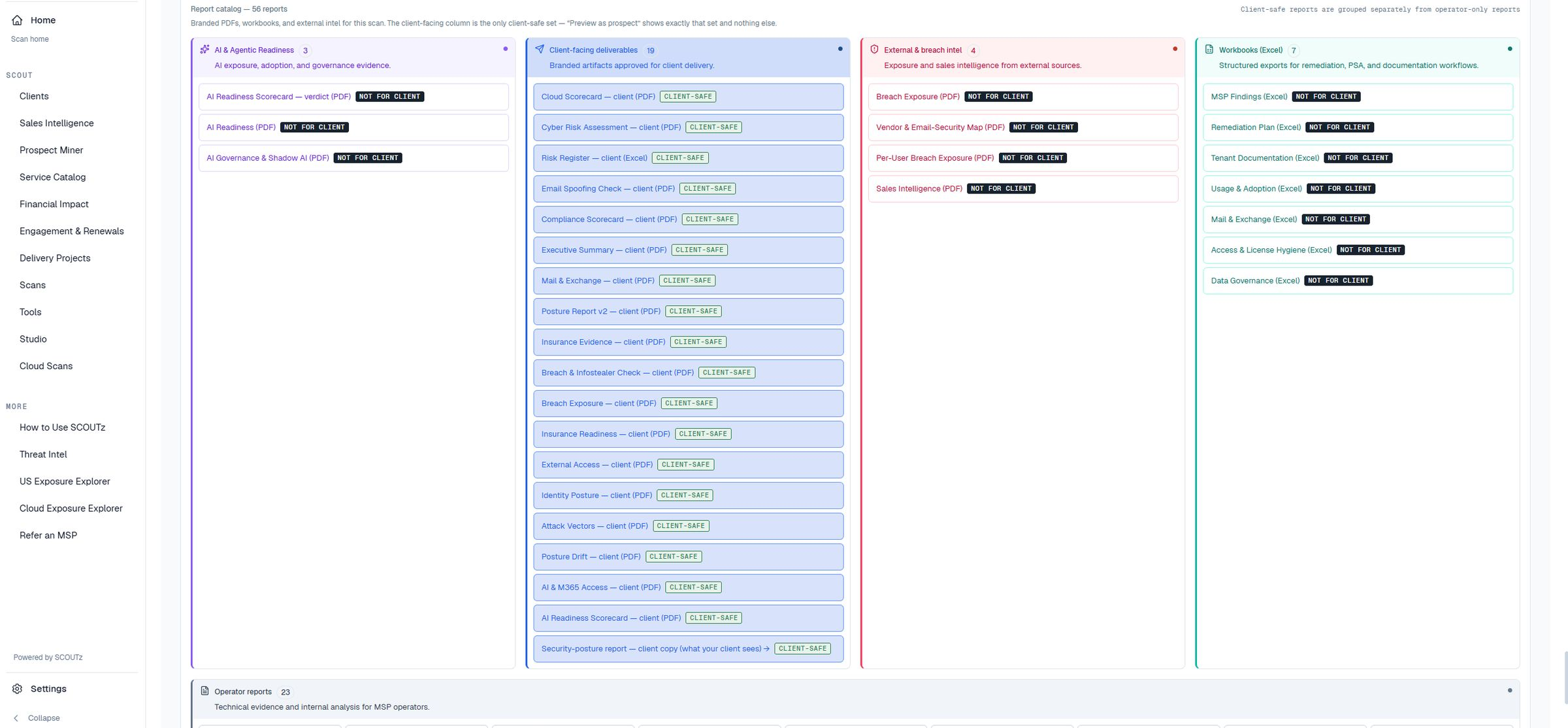
Real Product / Anonymized: official SCOUTz Studio client-safe report capture; retained as an illustrative product capture, not current customer results This is an interface illustration, not evidence of the technical condition discussed in this article.
MSP sales proof assets are the evidence a buyer can inspect before accepting a service claim. Build them around the buyer's decision: the current condition, the proposed work, who owns it, what remains uncertain, and how the result will be verified.
MSP sales proof assets are the evidence a buyer can inspect before accepting a service claim. Build them around the buyer's decision: the current condition, the proposed work, who owns it, what remains uncertain, and how the result will be verified.
TL;DR
- An MSP sales proof checklist should cover outcomes, differentiation, relevant evidence, and industry context.
- Kaseya's 2026 survey reports 19% selecting difficulty demonstrating value, compared with 10% previously.
- A report, case study, proposal, and verification record prove different things; do not treat them as substitutes.
- SCOUTz supports dated prospect evidence and client-safe reporting; the MSP remains responsible for the sale and delivery.
- Start with the SCOUTz sample-report overview to understand the distinction between owner-facing explanation and operator evidence. A buyer needs a clear decision; the technician needs the source behind it.
Why proof assets matter for MSPs
Kaseya's 2026 State of the MSP Report found 19% of respondents selecting difficulty demonstrating value quickly as their biggest customer-acquisition challenge, compared with 10% in the previous comparison. It also reports 17% selecting difficulty creating and maintaining consistent client documentation, compared with 10% previously.
These figures describe selected obstacles, not measured effects on sales. They support inspecting the proof process; they do not establish that a new checklist will improve close rates.
The MSPeasy playbook organizes prospect expectations into four areas: clear business outcomes, meaningful differentiation, relevant proof, and industry understanding. That is a useful review framework, provided each area is backed by evidence rather than a more confident adjective.
For a 2026 sales team, the aim is not to accumulate documents. It is to make each material claim traceable to the right source and each proposed next step understandable to the buyer.
Compare the proof assets by the decision they support
| Asset | Best for | What it supports | Main limitation |
|---|---|---|---|
| Outcome brief | Agreeing on the business problem | The buyer's objective and stated consequence | An objective is not a delivered result |
| Scope comparison | Evaluating different service approaches | Included work, exclusions and responsibilities | A feature grid alone does not prove performance |
| Evidence summary | Reviewing observed conditions | Source, date, finding and limits | A finding does not establish buying intent |
| Verified case study | Evaluating prior delivery | Documented history for a real customer | Does not guarantee repetition |
| Industry-context note | Testing relevance to the buyer's workflow | Questions and constraints that matter in that context | Familiar terminology does not prove expertise |
| Authorization record | Approving the next review | The agreed evidence and access boundary | Read-only does not mean unlimited permission |
| Verification record | Establishing what changed | A supported before-and-after observation | Does not establish unobserved outcomes |
These assets form a decision chain, not a mandatory pile of attachments. Use the smallest set that answers the actual buyer question. Sending everything can obscure the evidence that matters.
Build an MSP sales proof library in seven steps
1. Capture the business outcome before presenting the stack
Write the customer's objective in a form the customer recognizes. Keep a stated goal separate from your assumption about the technical cause.
For example, a buyer may want clearer ownership of external collaboration. That is not yet a finding that a particular app or sharing setting is wrong. The review should establish the relevant condition before a product is prescribed.
A manual outcome brief needs:
The buyer's stated problem. The responsible business owner. The operational consequence the buyer confirms. The decision currently being considered. The evidence still needed. Do not invent a loss figure because the brief feels incomplete without one. A defined uncertainty is a valid reason to investigate. It is not a license to model a breach that has not happened.
2. Make differentiation observable
Replace broad claims about being proactive or security-focused with a description of the work the buyer can inspect. What is reviewed? What evidence is returned? Who interprets it? How is a changed condition checked?
Your differentiation document should describe a process you actually deliver, including its limits. An impressive capability that belongs to a supplier but is not included in your service should not appear as an implied commitment.
Keep the comparison bounded:
Included review and delivery work. Customer responsibilities. Evidence sources and access requirements. Exclusions and dependencies. Verification and escalation process. A plain scope difference can be commercially meaningful without declaring another MSP incompetent. Compare what is documented, not what you assume the incumbent does.
3. Assemble a source-labeled evidence summary
Start manually with a reviewed finding and its source. The summary should preserve the observation date, evidence boundary, interpretation, and next validation question.
Public-domain evidence and customer-approved tenant evidence belong in separate categories. A published email-authentication record can support a question about the intended policy. It does not establish internal MFA enforcement or prove email fraud occurred.
SCOUTz prospect intelligence organizes dated public observations and authorized Microsoft 365 evidence for preparation. SCOUTz keeps unread evidence unknown rather than treating it as clean.
An evidence-summary template should include:
- What was observed.
- Which source supports it.
- When it was collected.
- What the observation does not establish.
- What the MSP proposes to validate next.
- This is where evidence becomes useful to a seller without becoming a stronger claim than the source can support.
4. Use case studies only when the underlying result exists
A case study is evidence about prior work. It needs a real customer history, permission to use the material, a defined scope, and substantiated results.
If your MSP does not have an approved case study for a particular outcome, do not manufacture a composite story and present it as a customer result. An explicitly illustrative workflow can teach the process, but it is not social proof.
For each case study, retain:
The approved customer description. The starting condition and period. The work actually performed. The measured or independently verified result. Limits on attribution or generalization. Avoid counterfactual claims that a client avoided a specific breach loss unless there is evidence sufficient to support the assertion. A successful configuration change is not proof of a hypothetical incident's cost.
5. Demonstrate industry understanding through better questions
Industry understanding is not a paragraph full of sector vocabulary. Show that you understand the relevant workflow, decision-maker, data boundary, and service dependency.
For a business using external contractors, ask who approves access and what ends it. For a business dependent on a particular inbox, ask who owns continuity and account recovery. The relevance comes from the workflow, not a generic statement that every company faces the same risk.
An industry-context note should contain:
The workflow being assessed. The business owner who can validate it. The relevant supplier or system dependencies. The evidence needed for the specific question. Any specialist review outside the MSP's current scope. Do not turn a security assessment into a compliance certification. If a legal or regulatory conclusion requires specialist interpretation, state that boundary instead of borrowing authority from a checklist.
6. Define authorization for the next evidence layer
When the next decision requires internal evidence, explain the proposed access in advance. State who approves it, what will be collected, how it will be used, and who will receive the result.
SCOUTz Microsoft 365 reviews require customer-approved read-only access. A public-domain review uses public sources and has no product permission gate, but that product workflow is not blanket legal clearance for every collection method or jurisdiction.
Your authorization asset should preserve:
Systems and identities in scope. Permitted collection methods. Access and data boundaries. Report recipients. Stop conditions and responsible contact. Do not ask the buyer to approve an undefined scan. The authorization should describe a task clearly enough that the customer understands what is, and is not, happening.
7. Write the verification plan before work begins
A promise becomes testable when the proposal names the expected condition and the evidence that will confirm it. Define this before implementation rather than after someone marks the work complete.
A verification plan is not a guarantee. It is an agreement about how the result will be assessed and what remains outside the check.
Retain:
The starting evidence and date. The approved work and owner. The expected observable condition. The validation method. The limits of the conclusion. The next decision if validation fails. SCOUTz supports dated evidence checkpoints; the MSP owns operational changes and delivery. A rescan can establish a changed observed condition without proving the absence of every future incident.
Match the proof to the buying stage
A first conversation rarely needs the same packet as implementation approval. Sequence the evidence around the decision rather than around your internal folder structure.
| Stage | Buyer question | Useful asset | Asset to avoid substituting |
|---|---|---|---|
| Initial conversation | Why is this relevant to us? | Bounded observation and discovery question | A claim of confirmed breach from a public signal |
| Review approval | What are we authorizing? | Scope and access record | A vague assessment label |
| Proposal evaluation | What will you do differently? | Evidence-led scope and responsibility comparison | An undifferentiated vendor stack |
| Implementation acceptance | Did the work achieve the agreed condition? | Verification record | A closed ticket alone |
| Ongoing review | What changed and what remains? | Updated evidence and owned action list | Repeated historic findings without revalidation |
The 2026 proof problem is not solved by moving the same attachment through every stage. Preserve the source while changing the explanation to fit the decision.
A reusable client-facing proof card
Use this as a manual template, not as a fictitious customer finding.
Observation: State the supported condition without interpreting intent.
Source and date: Identify where the evidence came from and when it was collected.
Meaning: Explain the business question the condition raises. Mark the explanation as an interpretation when necessary.
Limit: State what has not been established, including unread or unassessed areas.
Decision: Name what the customer is being asked to authorize or confirm.
Owner and verification: Identify the responsible party and what evidence would establish the result.
SCOUTz prospect intelligence supports this evidence-to-conversation structure. SCOUTz is suited to MSP teams that need dated, source-labeled preparation rather than unsupported promises about sales outcomes. SCOUTz does not replace the relationship, business qualification, or technical judgment.
Common mistakes in MSP proof libraries
Using an industry statistic as a client result. Kaseya's 19% response share does not establish that your prospect has a documentation problem or that a particular tool will fix it.
Writing illustrative stories as case studies. Label examples clearly. A plausible scenario is not a verified customer history.
Letting the salesperson and technician use different certainty. The client-safe report may be shorter, but it must not turn an inference into an observation.
Treating a document as permanent proof. A source date matters. Conditions change, access changes, and a previously valid finding can become stale.
Presenting a review as autonomous remediation. State who implements changes and how approval works. Evidence collection and delivery execution are different jobs.
Measure whether your proof library is useful
Use internal records to examine preparation effort, missing evidence, unanswered buyer questions, and decisions reached. Review whether another team member can reproduce the claim from the source.
If you test a revised proof packet, keep opportunity maturity and selection differences visible. Do not attribute every later sale to a document when price, timing, relationships, and fit also changed.
The 2026 reports provide no guaranteed lift from a proof checklist. Your useful outcome is initially operational: a claim can be checked, a scope can be understood, and the next task has an owner. Commercial conclusions need your own evidence over time.
Sources and scope
Kaseya, MSPeasy: Marketing and sales playbook for growing MSPs, pages 3–6. Used for the four proof areas and sales-process context. Kaseya, 2026 State of the MSP Report, pages 7 and 31–34. Survey of 1,061 MSPs conducted November 2025; reported obstacles are self-reported response shares. The seven-step library and proof-card template are editorial recommendations, not findings from a separate study or documented SCOUTz customer results.
FAQ
What proof assets should an MSP have for sales?
Prepare assets that explain the buyer's outcome, observed conditions, scope, responsibilities, authorization, and verification. Use real case studies only when the underlying customer result is documented and approved.
Does every first meeting need a full security report?
No. Match the asset to the decision. A bounded observation and a useful validation question can be more appropriate than a large report.
Can an industry statistic prove a prospect has a problem?
No. Industry findings provide context. A customer-specific conclusion needs evidence from the relevant customer and source.
Can an illustrative example be called a case study?
Not as a real customer result. Label the example illustrative and keep it separate from verified customer history.
Does an evidence-led proof library guarantee more sales?
No. The supplied reports do not establish a guaranteed commercial improvement. Evaluate outcomes using your own opportunity and customer records.
Where does SCOUTz fit in the checklist?
SCOUTz supports dated public-source and customer-approved Microsoft 365 evidence, client-safe explanations, and review preparation. The MSP owns qualification, the relationship, implementation, and the sale.
One last thing
A buyer should be able to challenge your interpretation without losing access to the evidence. If the source only survives inside the seller's explanation, the proof asset is not finished.
To evaluate SCOUTz prospect intelligence with your next real preparation task, Join Open Beta.
Related guides
Why the buyer's decision needs more than a stack and a price
Why completed work needs verification
Explore the relevant SCOUTz workflow · Review a sample report · Join Open Beta