
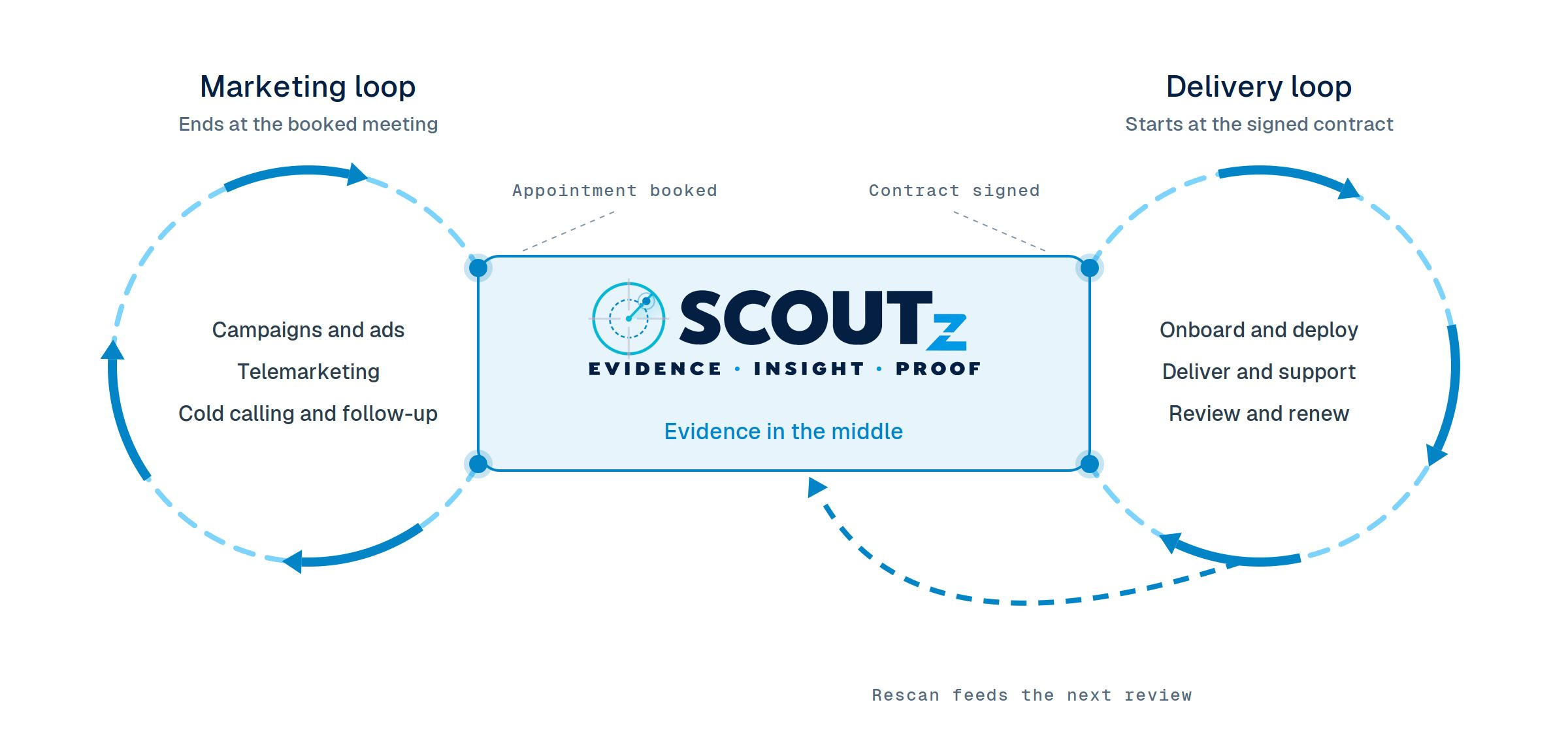
Illustrative SCOUTz missing-middle diagram: marketing ends at a booked meeting; delivery starts at a signed contract This is an interface illustration, not evidence of the technical condition discussed in this article.
Kaseya's 2026 State of the MSP Report found that 71% of respondents selected acquiring new customers among their top three business issues. That measures reported difficulty, not acquisition cost, close rate, or proof that a particular sales tool works.
Kaseya's 2026 State of the MSP Report found that 71% of respondents selected acquiring new customers among their top three business issues. That measures reported difficulty, not acquisition cost, close rate, or proof that a particular sales tool works.
TL;DR
- MSP customer acquisition benchmarks need denominators: 71% selected acquisition among their top three business issues.
- Difficulty demonstrating value rose from 10% to 19% in the report's year-over-year comparison.
- SCOUTz supports dated prospect evidence; the MSP owns qualification, the relationship, and the sale.
- Use survey findings to choose questions, not to predict your own conversion rate.
- For the distinction between an appointment and a buying decision, read the SCOUTz missing-middle field note.
MSP customer acquisition benchmarks at a glance
These are survey findings, not performance targets. Each row preserves the question being asked because percentages from different questions do not have interchangeable meanings.
| Measure in Kaseya's 2026 report | Reported result | What it supports | What it does not establish |
|---|---|---|---|
| Acquisition as a top-three business issue | 71% | Acquisition was the most frequently selected issue | 71% failed to acquire customers |
| Priority to add new clients | 88% | Adding clients was a selected priority | A forecast of client growth |
| Competition as biggest acquisition challenge | 22% | Competition was a selected obstacle | Competitors caused every lost proposal |
| Difficulty demonstrating value quickly | 19%, versus 10% previously | More respondents selected this obstacle | An assessment improves close rates |
| Difficulty maintaining consistent documentation | 17%, versus 10% previously | Documentation was a growing selected obstacle | Every MSP lacks documentation |
| New clients mostly switching providers | 33% | These MSPs reported mostly switching clients | 33% of all new clients switched |
| Mixed switchers and first-time users | 49% | These MSPs reported a mixed profile | The customer-level split within each MSP |
| Mostly first-time MSP users | 12% | These MSPs primarily served new adopters | A complete distribution of market demand |
Methodology: Kaseya surveyed 1,061 MSPs worldwide in November 2025 for the 2026 report; 76% of respondents were in North America. These are self-reported responses from a vendor-sponsored survey, not a census or a verified matched panel across years.
Among the acquisition-specific obstacles displayed, competition leads at 22%, followed by demonstrating value at 19% and documentation at 17%. A harder market and an inconsistent proof process are different problems even when both appear in the same pipeline.
Why this matters
A headline about difficult customer acquisition can make every stalled deal look like a demand problem. It does not tell you whether the bottleneck sits before the meeting, during discovery, at the proposal, or after the decision-maker disappears.
The 2026 report describes several stages. Adding clients is a priority. Acquiring clients is a reported issue. Demonstrating value is one selected obstacle inside acquisition. Those statements belong together, but they are not substitutes for one another.
A useful benchmark prompts you to inspect your process. It does not belong in a forecast until your own records support the connection. You still need opportunity histories to decide what is wrong.
What changed in the value-proof responses?
Difficulty demonstrating value increased from 10% to 19%. That is a 9-percentage-point increase, or a 90% relative increase in the reported share. Neither formulation means the typical MSP lost 90% more business.
Documentation difficulty increased from 10% to 17%, a 7-percentage-point increase. The survey does not establish that documentation caused the change in value-proof difficulty. It shows two related problems worth checking separately.
Start with actual opportunities. Can another salesperson reconstruct what was observed, what the buyer confirmed, what remains uncertain, and why the proposed work fits? If those records are missing, a polished slide deck will not fill the gap.
A usable opportunity note contains:
The buyer's objective in the buyer's words. The observed condition and its source. The collection date. The possible business consequence, identified as an interpretation. The next decision and its owner. The evidence needed before making a stronger claim. These fields are an operating recommendation, not a measured formula from the survey. Their purpose is to keep the salesperson's explanation connected to something a buyer can inspect.
Does 71% mean acquisition is every MSP's single biggest issue?
No. Figure 2 asked respondents to select exactly three issues. The 71% result means acquisition appeared in those selections. It does not mean respondents individually ranked it first, although acquisition had the highest selection share.
A precise sentence is: Acquiring new customers was the most frequently selected top-three business issue in Kaseya's 2026 MSP survey. That is strong enough without changing the question.
This distinction matters in educational content. A business owner who checks the report should find the same meaning, not a more dramatic claim that only exists in your headline.
It also matters in planning. Profitability, delivery capacity, competition, and acquisition can all constrain the same business. Assigning one winner to a multi-select question hides that overlap and can send investment toward the wrong stage.
Does the switching data establish buying intent?
No. The report says 33% of responding MSPs described their new clients as mostly switching from another provider. Another 49% described a mixture of switchers and first-time users, while 12% reported mostly first-time users.
The unit is the responding MSP, not an individual customer. You cannot add the first two figures and claim 82% of prospects want to replace their provider. The displayed categories also do not account for every respondent.
For an account with an incumbent provider, investigate the decision:
What works today and must not be disrupted? What business change created this conversation? Who owns the existing agreement and renewal? What would make staying with the incumbent the right answer? Which gaps are confirmed, and which remain assumptions? A public-domain observation does not answer these questions. It supplies a starting point; it does not prove dissatisfaction, budget, urgency, or authorization to inspect private systems.
Compare sales approaches by the question they answer
Different approaches support different jobs. Treating them as substitutes creates the same confusion as treating every survey percentage as a conversion benchmark.
| Approach | Best for | Useful evidence | Main limitation |
|---|---|---|---|
| Educational content | Explaining recurring business issues | Sourced guidance and real examples | Does not establish a prospect's condition |
| Public-domain review | Outside-in preparation | Dated published records | Cannot establish internal tenant controls |
| Authorized Microsoft 365 review | Supported internal conditions | Read-only, source-labeled evidence | Depends on permissions and coverage |
| Case study | Previously documented outcomes | Verified customer history | Does not promise the same outcome elsewhere |
| Opportunity review | Diagnosing sales-stage losses | Your own stage history and buyer explanations | Weak records produce weak conclusions |
Kaseya's MSPeasy playbook recommends outcomes, differentiation, relevant proof, and industry understanding. These are useful categories for organizing a sales process. The ebook is not a second independent survey or a controlled demonstration that one approach causes growth.
How to use the 2026 benchmarks
Separate demand creation from meeting preparation
Track where opportunities originate and where they stop. A demand-creation problem concerns reaching suitable accounts. A preparation problem concerns what the buyer can evaluate once the meeting happens.
Keep these states separate:
Suitable account identified. Meeting booked and held. Buyer objective confirmed. Authorized review agreed where needed. Defined work proposed. Decision recorded, including no decision. Do not turn labels into a forecast until historical records support one. A calendar event is not a qualified opportunity simply because somebody accepted an invitation.
If your records show many suitable meetings but few agreed next steps, inspect the meeting-to-decision handoff before assuming more outreach is the answer. If suitable meetings are scarce, an assessment presentation alone cannot solve that shortage.
Build a proof chain instead of a fear slide
Keep source, limitation, interpretation, and verification together. A technical finding requires context before it supports a business recommendation.
For example, a published DMARC monitoring-only policy supports a question about the intended email-authentication plan. It does not prove fraudulent mail reached customers or the current provider failed.
SCOUTz prospect intelligence is built for MSP meeting preparation, not for predicting which prospect will buy. SCOUTz organizes dated public-domain observations and customer-approved Microsoft 365 evidence. It does not replace the conversation that establishes need, fit, and authority.
The buyer should be able to disagree with an interpretation without disputing the underlying record. That is easier when the report separates what was observed from what the MSP proposes to investigate.
Measure completed decisions, not just busy calendars
Use consistent entry and exit rules for comparable opportunities. Otherwise a recordkeeping change can look like a sales improvement.
When testing an evidence-led brief, record preparation time, meeting outcomes, agreed next steps, and eventual paid customers. Keep immature opportunities separate from completed decisions. Do not attribute every subsequent win to the brief when pricing, relationships, fit, or timing also changed.
The report provides no universal acquisition-cost target. Your service margin, delivery cost, contract terms, and acquisition history must supply that calculation.
A statistic-review sheet for your team
Before a number enters outreach or a proposal, complete four checks. This is a proposed editorial control, not another survey finding.
Name the population. Is the statistic about respondents, accounts, businesses, alerts, or customers? Preserve the question. Was it single-choice, top-three, or unlimited selection? Preserve the period. The report is labeled 2026, but the MSP survey occurred in November 2025. State the limit. Which conclusion requires customer-specific evidence or a different study? This catches a common mistake: an accurate number attached to the wrong noun. Respondents become customers, concerns become incidents, and selected priorities become purchase commitments. The number survives while its meaning disappears.
Apply the same discipline to your own results. A percentage based on proposals sent answers a different question from a percentage based on meetings held. Label both if both are useful; never merge them for a stronger-looking claim.
What the report cannot tell your MSP
The supplied material does not provide a universal close rate, verified acquisition cost, evidence-tool return, or causal test of evidence-led selling. It also does not establish that the same individual MSPs produced every year-over-year change.
Those limits define the proper use: market context, team questions, and hypotheses to examine against your records. The proof and documentation responses justify investigating your preparation process. They do not justify guaranteed revenue claims.
A sensible review ends with a specific unanswered question about your business. Which opportunities lacked a named decision-maker? Which proposals rested on a finding the customer had already resolved? Which buyers needed delivery references rather than another technical report? The survey cannot answer these; your records and buyer conversations can.
Sources and interpretation
Kaseya, 2026 State of the MSP Report, pages 5–8 and 31–34. Survey conducted November 2025; comparisons retained as labeled. Kaseya, MSPeasy: Marketing and sales playbook for growing MSPs, pages 3–6. Used as a process framework, not additional independent statistical evidence.
FAQ
What is the main MSP customer acquisition benchmark in the 2026 Kaseya report?
Acquiring new customers was selected among the top three business issues by 71% of respondents. That measures reported difficulty, not a close rate or acquisition cost.
How many MSPs struggle to demonstrate value quickly?
In the 2026 report, 19% selected difficulty demonstrating value as their biggest acquisition challenge, compared with 10% previously. These are survey responses, not measured sales losses.
Does the report show most prospects want to switch MSPs?
No. It describes responding MSPs' new-client profiles. It does not measure current buying intent across prospects.
Can an MSP use the 71% figure in marketing?
Yes, with attribution, period, and question scope preserved. State that respondents selected acquisition among their top three business issues.
Does security evidence guarantee a higher close rate?
No. Dated evidence supports preparation and verification. These reports do not establish a guaranteed sales improvement from an assessment or software product.
Where does SCOUTz fit in MSP sales?
SCOUTz supports MSP prospect-intelligence preparation with dated public observations and customer-approved Microsoft 365 evidence. The MSP qualifies the opportunity, interprets findings, owns the relationship, and closes the deal.
One last thing
A useful benchmark narrows your next question. A misleading benchmark makes the answer sound settled before you have examined your business.
To evaluate SCOUTz prospect intelligence against a real preparation workflow, Join Open Beta. Bring an account and an evidence question, not an assumed close-rate improvement.
Related guides
How to evaluate MSP security-sales tools
Why stronger claims need stronger evidence
Explore the relevant SCOUTz workflow · Review a sample report · Join Open Beta