
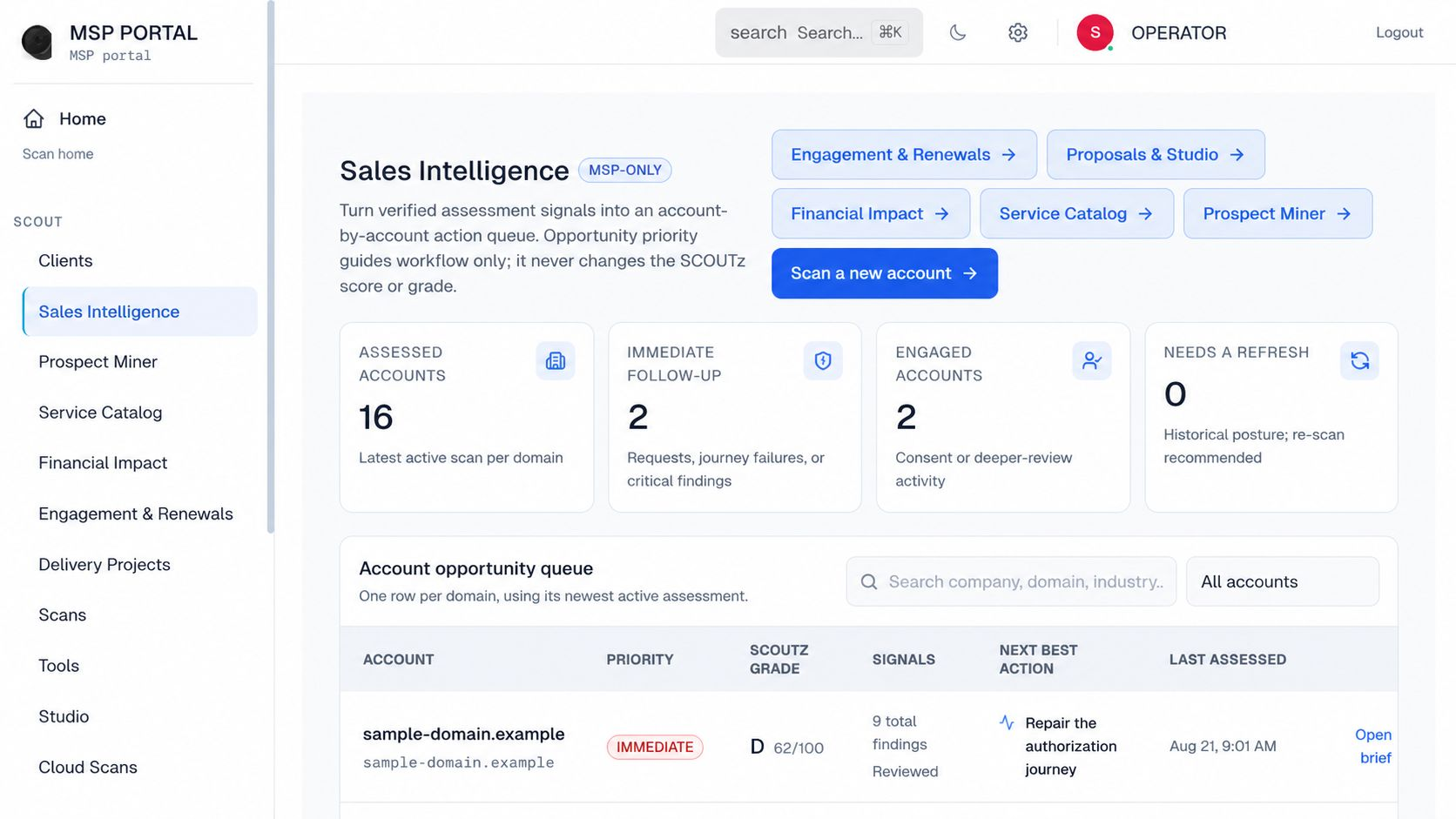
Real Product / Anonymized: official SCOUTz operator sales-intelligence capture; no implied visibility into private AI prompts This is an interface illustration, not evidence of the technical condition discussed in this article.
Kaseya's 2026 MSP survey reports that 48% of respondents selected AI and automation among their clients' top three IT needs, while 13% selected it among their own top three revenue sources. The difference is 35 percentage points between two survey response shares, not a measured revenue shortfall or a forecast of money available to your MSP.
Kaseya's 2026 MSP survey reports that 48% of respondents selected AI and automation among their clients' top three IT needs, while 13% selected it among their own top three revenue sources. The difference is 35 percentage points between two survey response shares, not a measured revenue shortfall or a forecast of money available to your MSP.
TL;DR
- MSP AI demand vs revenue compares different survey questions: 48% selected client needs; 13% selected revenue sources.
- Neither percentage measures AI's share of client budgets or MSP revenue.
- The survey supports investigating specific client needs, not promising an automatic AI revenue opportunity.
- SCOUTz supports AI-related application evidence review without claiming visibility into private prompts or embedded agent activity.
- Start with the SCOUTz AI governance boundary: observed application relationships, permission scope, and available evidence are different from an imagined view of every employee's AI use.
MSP AI demand vs revenue: the 2026 survey figures
| Survey measure | Reported share | Question scope | What it does not measure |
|---|---|---|---|
| AI and automation as a client need | 48% | Respondents selected exactly three needs | AI's share of all client demand |
| Security as a client need | 42% | Same client-needs question | Share of client budgets |
| Backup and recovery as a client need | 36% | Same client-needs question | Purchase commitments |
| AI and automation as a top revenue source | 13% | Respondents selected exactly three sources | AI's share of total MSP revenue |
| AI and automation offered | 38% | Service-offerings question allowed multiple selections | Percentage delivering profitable AI services |
| AI used for IT-task automation | 53% | Current AI applications; multiple selections allowed | Workload automated or time saved |
| AI used in sales and marketing | 26% | Same current-use question | Share of sales produced by AI |
| Not using AI yet | 15% | Same current-use question | Lack of client interest |
Methodology: Kaseya's 2026 State of the MSP Report surveyed 1,061 MSPs worldwide in November 2025. North America accounted for 76% of respondents. The findings are self-reported, and different questions have different selection rules; they are not observed purchasing or revenue transactions.
AI and automation leads the displayed client-needs categories at 48%, ahead of security at 42% and backup at 36%. Its 13% top-revenue-source share is a different measure and must remain labeled as such.
Why this matters
It is tempting to describe the difference as a huge untapped AI market. The survey does not calculate that market. It describes what MSPs believe clients need and which services respondents identify as major revenue contributors.
A useful 2026 interpretation is narrower: client interest and commercial maturity do not appear identical in these responses. That supports asking whether a specific client has a defined problem the MSP can responsibly address.
The result is not permission to rename an existing service AI and promise growth. Business need, authorized evidence, delivery capability, and a measurable outcome still have to be established.
What does the 35-percentage-point difference mean?
The arithmetic is straightforward: 48 minus 13 equals 35 percentage points. The interpretation is not a conversion rate because the two numbers answer different questions.
The first concerns perceived client needs. The second concerns selected revenue sources. The survey does not show how the same respondents answered both questions together, how much each earned from AI, or how much clients planned to spend.
Avoid these conclusions:
Only 13% of MSP revenue comes from AI. The remaining 35% of demand is unserved. An MSP can capture the difference by launching a package. Every respondent seeing demand has a client ready to buy. A precise sentence is stronger: Kaseya's 2026 survey shows AI and automation more frequently selected as a client need than as a top MSP revenue source. That statement preserves both the signal and the uncertainty.
Offering AI services does not establish a profitable AI business
The report says 38% of respondents offer AI and automation services. That is not inconsistent with 13% selecting the category among their top revenue sources.
A provider can offer a service that is not one of its largest revenue contributors. Service availability, sales volume, recurring revenue, and profitability are different measurements.
The survey does not establish the share of AI offerings that are profitable, their margins, contract sizes, retention, or delivery hours. Do not fill those gaps with industry-wide assumptions presented as sourced findings.
For your own MSP, ask separate questions:
- What exactly is offered?
- Which customers bought it?
- What work was delivered?
- What costs were incurred?
- What outcome was verified?
- What recurring obligation remains?
- That sequence turns a broad category into something the business can evaluate.
Internal AI adoption is not the same as a client service
Kaseya reports 53% using AI for IT-task automation and 26% using it in sales or marketing operations. Those are adoption selections, not percentages of work automated or productivity gains.
An internal ticket-summary workflow can be useful without becoming a client service. A customer-facing readiness review can be useful even when it does not build a custom agent. The commercial question is whether there is a defined customer problem and a supportable deliverable.
Keep the categories separate:
| Work type | Best for | Possible evidence | Main limitation |
|---|---|---|---|
| Internal MSP automation | Improving the provider's own workflow | Measured internal process results | Does not establish client demand |
| Client application-governance review | Understanding supported application relationships | Authorized identity, ownership and permission records | Does not show every employee action |
| Client workflow discovery | Defining a business use case | Interviews, process maps and approved observations | Discovery does not establish implementation success |
| Client implementation project | Delivering an agreed workflow | Acceptance tests and documented handover | Requires delivery capability and ongoing boundaries |
These are service-design options, not ranked products or a claim that SCOUTz implements all four. Select the job before selecting the software.
How to use the findings in a client conversation
Start with the business process, not the AI application
Ask which repetitive decision, document handoff, or service interaction causes a real operational problem. Record the current owner and the consequences the client can confirm.
Do not promise time savings before measuring the process. A workflow can look repetitive but depend on exceptions, tacit judgment, or sensitive data that change its suitability.
For a first review, document:
The process and its responsible owner. The current input and expected output. The decision that requires human approval. The data categories involved. The failure conditions the business will not accept. These are proposed discovery fields, not survey findings. They prevent the survey's broad interest signal from becoming a predetermined product pitch.
Establish the evidence and authorization boundary
A public reference to an AI vendor is context, not proof of internal deployment. An application relationship in Microsoft 365 is stronger evidence of a connection, but it does not prove every assigned user is active or that private information was sent to the service.
Customer-authorized read-only evidence can support questions about publisher, owner, consent, permission scope, assignment, and available activity. Keep each layer labeled.
SCOUTz prospect intelligence supports preparation from dated sources. SCOUTz does not read prompts, private messages, files, or documents and does not claim a complete view of agents embedded inside other software.
Define a deliverable the client can evaluate
Do not sell AI readiness as a universal certification. Define which decision the review supports and what evidence will be returned.
A bounded application-governance review might deliver an observed application inventory within stated sources, ownership questions, permission-review priorities, and a client-approved decision register. It should also state what was not assessed.
A workflow-discovery engagement has a different deliverable: a validated problem statement and implementation requirements. Combining the two without naming the boundary makes scope hard to understand and outcomes hard to verify.
Set an acceptance test before implementation
If the client approves an implementation, define the outcome and validation method before work begins. The acceptance test should evaluate the actual workflow, not whether an AI vendor was activated.
Possible dimensions include output accuracy, review requirements, access scope, exception handling, and the business owner's approval. Actual numeric targets must come from the client's requirements and baseline, not this report.
For a 2026 service launch, the absence of a benchmark is not a reason to invent one. Measure the current process and agree on what counts as acceptable before presenting a return estimate.
Keep support and change ownership explicit
A workflow that works once is not automatically a managed service. Identify who handles vendor changes, permission reviews, exceptions, failed runs, and the client's evolving requirements.
State whether the engagement ends at assessment, includes implementation, or creates an ongoing support commitment. Each boundary affects delivery cost and the evidence needed to claim a completed outcome.
SCOUTz Microsoft 365 evidence review helps organize supported observations; the MSP's operational stack and responsible team own approved changes. SCOUTz does not autonomously enforce policy or run the client's AI workflows.
How to discuss AI-related applications without overstating use
Keep five states distinct: presence, entitlement, permission, supported activity, and approved business use. They can coexist, disagree, or remain unknown.
Illustrative wording, not a customer result: A customer-authorized source showed an AI-related application relationship and its recorded permission scope. The review did not establish prompt content or complete employee usage. The business owner needs to confirm purpose and approval before the MSP proposes further work.
That sentence supports governance without becoming workplace surveillance. It also avoids declaring misuse merely because an application was not already on an approved list.
SCOUTz is suited to MSPs preparing evidence-led AI application reviews, not to proving every AI action across a business. SCOUTz's role is to keep the source and limit beside the observation.
What to measure in your own service experiment
Use your own delivery records to test whether an offering works. The survey cannot supply your economics.
Track:
The stated problem the client approved. Which evidence was available and missing. Time spent assessing and delivering the agreed work. The client's accepted output. Support and rework required afterward. Paid customer outcomes against the original scope. Do not use customer interest as booked revenue or a successful demonstration as a retained client. Those are different events. If the offering does not meet its acceptance criteria or consumes unsustainable support effort, revise the scope rather than claiming the market data proves it should work.
Source notes
Kaseya's 2026 State of the MSP Report, pages 14–22 and 31–34, supplies the survey figures. The client-needs and revenue-source questions asked for three selections; the offerings and current-AI-use questions permitted multiple selections.
The 2026 report does not provide a paired analysis linking these answers to verified client purchases or service profitability. This article's service-design workflow is an editorial recommendation, not an additional study or a claim about SCOUTz customer results.
FAQ
What does the MSP AI demand versus revenue gap measure?
It compares two selection shares in Kaseya's 2026 survey: 48% chose AI and automation among client needs, while 13% chose it among top revenue sources. It does not measure an unserved revenue pool.
Does AI produce 13% of MSP revenue?
The report does not establish that. Its 13% figure is the share of respondents selecting AI and automation among their top three revenue sources.
How many surveyed MSPs offer AI and automation services?
The report says 38% offer those services. That does not establish the proportion delivering them profitably.
Does internal AI adoption prove an MSP can sell AI services?
No. Internal adoption and a supportable client offering require different evidence. A commercial service needs a defined customer problem, scope, deliverable, and ownership.
Can SCOUTz see employee AI prompts?
No. SCOUTz does not inspect private prompts, conversations, messages, files, or documents. Its supported application evidence can inform a governance review.
What should an MSP do before pricing an AI service?
Define the client problem, authorized evidence, deliverable, acceptance criteria, and support boundary. Use the MSP's own baseline and delivery costs rather than treating survey interest as a forecast.
One last thing
The gap worth closing is between a client's stated problem and a result you can actually deliver. A market percentage cannot do that work for you.
To evaluate SCOUTz prospect intelligence with an evidence-led review, Join Open Beta.
Related guides
Why an AI service needs a boundary
What AI discovery can actually establish
Explore the relevant SCOUTz workflow · Review a sample report · Join Open Beta